
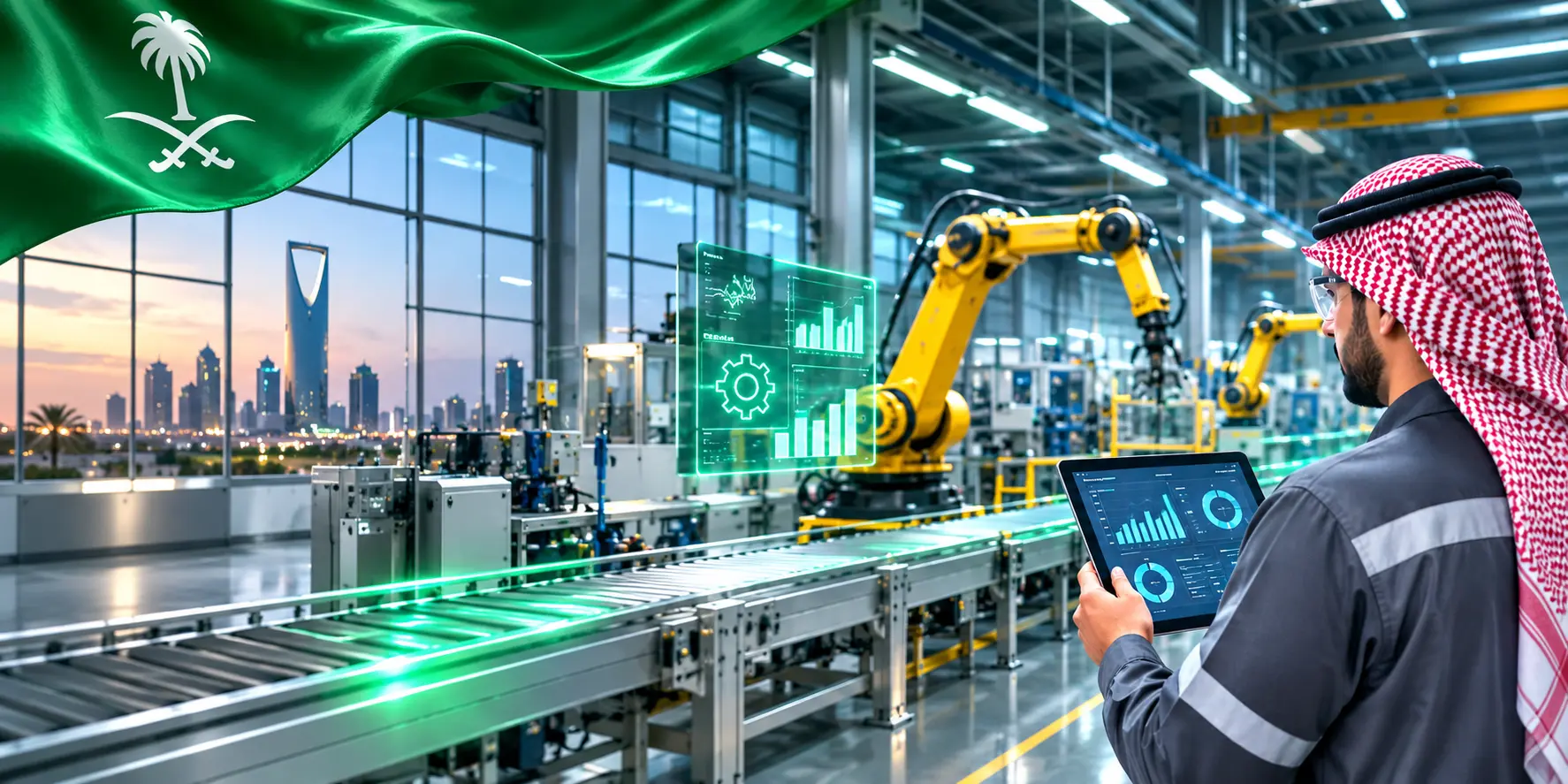
Saudi Arabia is undergoing a major industrial transformation. As part of its Vision 2030 strategy, the Kingdom is investing in advanced manufacturing technologies, automation, digital infrastructure, and smart industrial operations to strengthen its position as a global manufacturing hub.
For manufacturers operating in Saudi Arabia, this transformation presents a significant opportunity. Factories that traditionally depend on manual processes, disconnected software, and outdated production systems are increasingly encouraged to adopt modern digital technologies.
One of the important opportunities supporting this transformation is the Future Factories Initiative, which aims to help industrial facilities modernise their operations through automation, digitalisation, and Industry 4.0 technologies.
Eligible manufacturers may also explore financial support opportunities of up to SAR 300,000, depending on the applicable incentive programme, eligibility requirements, and approval conditions.
But what exactly is the Future Factories Initiative? Who can benefit? What technologies can manufacturers implement? And how can businesses prepare to access available financial support?
In this comprehensive guide, we explain everything manufacturers need to know about Saudi Arabia's Future Factories Initiative and how digital transformation solutions such as Odoo ERP can help build smarter, more efficient factories.
What Is Saudi Arabia's Future Factories Initiative?
The Future Factories Initiative is part of Saudi Arabia's broader industrial transformation strategy, led by the Ministry of Industry and Mineral Resources.
The programme aims to transform traditional manufacturing facilities into modern, technology-driven factories by encouraging the adoption of automation, digital systems, advanced manufacturing technologies, and smart industrial practices.
A major objective of the programme is to support the transformation of 4,000 factories from traditional operating models towards greater operational efficiency, automation, and advanced industrial solutions.
This initiative supports the Kingdom's National Industrial Strategy and Vision 2030 objectives by improving manufacturing productivity, strengthening industrial competitiveness, and encouraging technology adoption.
Traditionally, many factories manage their operations through separate systems or manual processes. Production teams may use spreadsheets, inventory departments may maintain separate stock records, and finance teams may operate independent accounting software.
This creates disconnected information, increases the possibility of human error, and makes it difficult for management to understand overall factory performance.
The Future Factories Initiative encourages manufacturers to overcome these challenges by introducing integrated digital technologies.
Key Objectives of the Future Factories Initiative
The initiative focuses on several important industrial development objectives:
- Digital Transformation: Encourage factories to adopt modern digital platforms and connected business systems.
- Industrial Automation: Reduce manual activities through automation technologies and intelligent manufacturing processes.
- Operational Efficiency: Improve production workflows, resource utilisation, and factory performance.
- Industry 4.0 Adoption: Connect machines, systems, and operational data through advanced technologies.
- Energy Efficiency: Encourage technologies that reduce energy consumption and improve resource management.
- Manufacturing Competitiveness: Help Saudi factories improve productivity and compete in domestic and international markets.
- Industrial Innovation: Support the adoption of commercially proven technologies and modern manufacturing practices.
The programme represents an important step towards building a more connected, efficient, and competitive industrial ecosystem in Saudi Arabia.
How Much Financial Support Can Manufacturers Receive?
One of the most attractive aspects of the Future Factories digital transformation opportunity is the availability of financial support for eligible industrial projects.
Manufacturers may explore support opportunities of up to SAR 300,000, depending on the specific programme, incentive track, project requirements, and approval conditions.
This can help reduce the financial challenges associated with introducing new technologies and upgrading existing manufacturing infrastructure.
For factories planning to implement ERP systems, automation, production management solutions, or digital integration technologies, financial support can make modernisation more achievable.
What Does the Financial Support Mean for Manufacturers?
Consider a manufacturing company planning to digitise its operations.
The factory currently manages production planning manually, uses separate software for accounting, and maintains inventory records through spreadsheets.
Management wants to introduce an integrated ERP platform to connect these departments.
The project may involve:
- ERP software implementation.
- Manufacturing and production management configuration.
- Inventory and warehouse management.
- Procurement and supplier management.
- Financial and accounting integration.
- Employee training and system adoption.
- Integration with existing operational systems.
These activities require investment, planning, and technical expertise.
Eligible financial support opportunities can help manufacturers explore these improvements while managing their project investment more effectively.
Important: The SAR 300,000 amount should be understood as a potential maximum support opportunity, not an automatic entitlement. The actual amount, eligible expenditure, funding structure, and approval process must be verified against the applicable official programme guidelines.
What Is Tanafusiya and How Does It Support Factory Digitalisation?
The Tanafusiya programme, offered through the Saudi Industrial Development Fund (SIDF), is an important financing and incentive mechanism supporting industrial competitiveness.
It focuses on helping factories adopt technologies that improve operational efficiency, reduce energy consumption, and strengthen manufacturing capabilities.
The programme includes two major areas of support.
A. Industrial Digital Transformation Track
This track focuses on adopting advanced technologies and connecting industrial machinery with digital systems.
The objective is to help factories improve operational efficiency through automation, digitisation, and Industry 4.0 technologies.
Examples include:
- Connecting production machinery with digital monitoring systems.
- Implementing integrated manufacturing management platforms.
- Digitising production planning and monitoring.
- Automating operational workflows.
- Improving data collection and reporting.
- Integrating equipment and business systems.
- Introducing technologies that support smart manufacturing.
B. Energy Efficiency Track
Energy efficiency is another important aspect of modern industrial operations.
Manufacturing facilities often consume significant amounts of electricity and other resources. Inefficient equipment and poor monitoring can increase operating costs.
The energy efficiency track encourages factories to adopt technologies and systems that improve energy performance.
Potential areas include:
- Energy monitoring and management systems.
- Energy consumption analysis.
- Equipment efficiency improvements.
- Energy auditing.
- Resource optimisation.
- Technologies that reduce unnecessary energy consumption.
Both tracks support the broader objective of building more productive and sustainable manufacturing operations.
Who Is Eligible for the Future Factories Initiative?
Eligibility depends on the specific programme and incentive track. Manufacturers should review the official requirements before preparing their applications.
For the SIDF Tanafusiya Accelerator Track, the published criteria include requirements relating to the factory's operational status, industrial licensing, technology selection, and project feasibility.
The programme specifically targets brownfield factories under this track.
Some of the important eligibility considerations include:
1. Valid Industrial Licences
Factories must hold the necessary licences and approvals required to operate legally in Saudi Arabia.
2. Active and Productive Operations
The proposed project should relate to an operational and productive industrial facility.
3. Relevant Digital Transformation Project
The project should focus on eligible areas such as automation, digitisation, or energy efficiency.
4. Commercially Proven Technologies
The technology selected for implementation should be commercially proven and suitable for the proposed industrial application.
5. Economic Feasibility
Manufacturers should demonstrate that the proposed project is financially and operationally viable.
6. Feasibility Study
A feasibility study should explain the project scope, expected benefits, capital expenditure (CAPEX), and operating expenditure (OPEX).
7. Programme Application and Approval
Applicants must follow the relevant programme application process and obtain the required approvals.
For Tanafusiya, the SIDF also specifies that the factory must obtain the relevant financing under the programme to qualify for its associated incentive arrangements.
Therefore, manufacturers should not assume that simply purchasing ERP software automatically makes them eligible for financial support.
5. Which Digital Technologies Can Help Factories Qualify for Transformation Support?
Digital transformation involves more than purchasing new software. It requires connecting business processes, improving data management, and making manufacturing operations more efficient.
Below are some of the major technologies manufacturers should consider when planning their digital transformation projects.
5.1 Enterprise Resource Planning (ERP)
ERP systems connect different business departments through a centralised platform.
Instead of managing accounting, inventory, procurement, sales, and production through disconnected applications, manufacturers can manage these activities within one integrated environment.
An ERP system can help factories:
- Monitor business operations.
- Manage inventory and warehouse activities.
- Track manufacturing orders.
- Control procurement activities.
- Manage supplier relationships.
- Monitor financial performance.
- Generate operational reports.
ERP implementation is an important foundation for building a digitally connected factory.
5.2 Manufacturing Resource Planning (MRP)
Manufacturing Resource Planning helps businesses organise and control their production activities.
It provides visibility into production requirements, raw materials, work orders, and manufacturing schedules.
With an MRP system, factories can:
- Create and manage Bills of Materials (BOM).
- Schedule manufacturing orders.
- Monitor production progress.
- Manage work centres.
- Track material consumption.
- Improve production planning.
- Reduce unnecessary production delays.
This allows manufacturers to organise production activities more systematically.
5.3 Industrial Internet of Things (IIoT)
Industrial Internet of Things technologies connect machinery, sensors, and equipment to digital monitoring systems.
This allows factories to collect operational information and monitor equipment performance.
Examples include:
- Machine performance monitoring.
- Equipment condition tracking.
- Temperature and pressure monitoring.
- Production data collection.
- Predictive maintenance.
- Real-time operational monitoring.
IIoT can help manufacturers identify operational issues earlier and improve production visibility.
5.4 Artificial Intelligence and Data Analytics
Artificial Intelligence and advanced analytics can help manufacturers turn operational data into useful business insights.
Potential applications include:
- Predictive maintenance.
- Production forecasting.
- Quality inspection.
- Demand forecasting.
- Resource optimisation.
- Production performance analysis.
These technologies can support better decision-making and improve manufacturing efficiency.
5.5 Warehouse Management Systems
Warehouse operations are an important part of manufacturing.
Poor inventory visibility can create production delays, unnecessary purchases, and stock management challenges.
Digital warehouse management systems help businesses track stock movements, manage storage locations, and improve inventory accuracy.
Features can include:
- Barcode scanning.
- Product tracking.
- Warehouse location management.
- Stock replenishment.
- Inventory valuation.
- Material movement tracking.
5.6 Business Intelligence and Management Dashboards
Management needs accurate information to understand how a factory is performing.
Business intelligence tools help collect and analyse operational data through reports and dashboards.
Managers can monitor:
- Production performance.
- Sales revenue.
- Inventory levels.
- Manufacturing costs.
- Procurement activities.
- Operational expenses.
- Business profitability.
This helps management make informed decisions based on actual business performance.
6. Why Should Saudi Manufacturers Invest in ERP Digital Transformation?
For manufacturers, implementing an ERP system is one of the practical steps towards building an integrated digital operating environment.
Many factories experience operational challenges because their departments work independently.
For example, when the sales department receives a new order, the production department may not immediately know the required quantities. The procurement team may not have updated information about raw material availability, while the finance department may maintain separate records.
These disconnected processes can affect the entire manufacturing workflow.
An integrated ERP platform addresses this problem by connecting business activities.
1. Centralised Business Management
ERP systems bring important business functions together within one platform.
Management can access information from different departments without depending on separate applications.
2. Improved Inventory Accuracy
Real-time inventory visibility helps factories understand available stock, material requirements, and replenishment needs.
3. Better Production Planning
Manufacturers can organise production schedules, manage manufacturing orders, and monitor work progress.
4. Reduced Manual Work
Automation reduces repetitive administrative activities and improves workflow consistency.
5. Better Financial Control
Integrated accounting provides better visibility into expenses, revenue, invoices, and operational costs.
6. Improved Supplier Management
Procurement teams can manage supplier information, purchase orders, delivery schedules, and purchasing activities more efficiently.
7. Data-Driven Decisions
Management dashboards and reports help decision-makers understand operational performance and identify areas for improvement.
7. How Odoo ERP Helps Transform Traditional Manufacturing Operations
Odoo ERP is an integrated business management platform that provides applications for manufacturing, inventory, procurement, accounting, sales, maintenance, and other business activities.
For manufacturers looking to move away from disconnected systems, Odoo provides an opportunity to centralise important business processes.
Through a properly planned Odoo implementation, factories can establish an integrated digital environment.
Odoo Manufacturing Module
The Manufacturing module helps businesses manage their production activities.
Key capabilities include:
- Bills of Materials management.
- Manufacturing orders.
- Work orders.
- Work centre management.
- Production planning.
- Manufacturing cost tracking.
- Component consumption.
- Production reporting.
Manufacturers can organise their production processes and gain better visibility into manufacturing activities.
Odoo Inventory Module
The Inventory module supports warehouse and stock management.
Important features include:
- Real-time inventory tracking.
- Warehouse management.
- Stock transfers.
- Product movements.
- Reordering rules.
- Lot and serial number tracking.
- Inventory valuation.
This helps factories improve stock accuracy and manage materials more effectively.
Odoo Purchase Module
The Purchase module helps manufacturers manage procurement and supplier relationships.
Features include:
- Vendor management.
- Purchase quotations.
- Purchase orders.
- Supplier pricing.
- Purchase agreements.
- Automated replenishment workflows.
It helps procurement teams organise purchasing activities and maintain better control over supplier operations.
Odoo Accounting Module
Financial management is essential for understanding manufacturing costs and overall business performance.
Odoo Accounting supports:
- Customer invoicing.
- Vendor bills.
- Expense management.
- Financial reporting.
- Bank reconciliation.
- Accounts payable and receivable.
- Financial analysis.
Odoo Quality Module
Quality management helps manufacturers maintain product standards throughout their production processes.
Businesses can establish quality control points, conduct inspections, and manage quality alerts.
This helps identify quality issues and improve manufacturing consistency.
Odoo Maintenance Module
Manufacturing equipment requires regular maintenance to avoid unexpected production interruptions.
Odoo Maintenance helps businesses:
- Schedule preventive maintenance.
- Manage maintenance requests.
- Track equipment information.
- Monitor maintenance activities.
- Organise maintenance teams.
Odoo Sales and CRM Modules
The Sales and CRM applications help businesses manage customer relationships, sales quotations, orders, and business opportunities.
When integrated with manufacturing and inventory, these applications provide better coordination between customer demand and production activities.
By implementing relevant Odoo applications, manufacturers can create a connected business management environment that supports operational efficiency and long-term growth.
8. How Manufacturers Can Apply for the Future Factories Initiative
Preparing a digital transformation project requires proper planning.
Manufacturers should understand their operational requirements, identify suitable technologies, and prepare the necessary project documentation before applying.
Here is a practical approach.
Step 1: Assess Your Factory's Current Digital Maturity
Begin by understanding how your factory currently operates.
Review existing processes across:
- Production management.
- Inventory and warehouse management.
- Procurement.
- Accounting and finance.
- Quality control.
- Equipment maintenance.
- Reporting and business analytics.
Identify areas where manual work, disconnected systems, and outdated processes are creating operational challenges.
Step 2: Identify the Digital Transformation Opportunities
Once the current situation is understood, determine which technologies can improve factory operations.
For example:
| Existing challenge | Potential digital solution | |---|---| | Manual production planning | Manufacturing ERP | | Disconnected inventory records | Digital inventory management | | Manual procurement | Automated purchasing workflows | | Poor production visibility | Manufacturing dashboards | | Equipment downtime | Maintenance management | | Disconnected departments | Integrated ERP platform | | High energy consumption | Energy monitoring systems |
This assessment helps manufacturers define a realistic transformation roadmap.
Step 3: Develop a Digital Transformation Roadmap
A transformation roadmap should explain what the factory wants to achieve and how the proposed technology will support those objectives.
It should include:
- Existing operational challenges.
- Proposed digital technologies.
- Project objectives.
- Implementation scope.
- Required software and hardware.
- Expected operational improvements.
- Estimated implementation costs.
- Project timeline.
- Training and adoption requirements.
A clear roadmap helps demonstrate the project's purpose and feasibility.
Step 4: Prepare the Technical and Financial Documentation
Manufacturers should prepare the supporting documentation required by the relevant programme.
Depending on the applicable application track, this may include:
- Industrial licence information.
- Company registration details.
- Factory operational information.
- Project proposal.
- Technical specifications.
- Feasibility study.
- Capital expenditure estimates.
- Operating expenditure estimates.
- Expected financial and operational benefits.
- Relevant financial statements.
Applicants should confirm the latest documentation requirements with SIDF before submission.
Step 5: Check Eligibility and Programme Requirements
Review the official guidelines for the specific incentive or financing track.
Confirm that the factory, project, technology, and proposed expenditure meet the relevant conditions.
For example, Tanafusiya has specific requirements relating to operational factories, commercially proven technologies, economic feasibility, and SIDF financing.
Step 6: Submit the Application
Access the relevant official government platform and follow the application instructions.
The official Future Factories application service provides an electronic application process through the national government portal.
Applicants should:
- Access the relevant initiative page.
- Select the application option.
- Complete the required application form.
- Upload supporting documents.
- Review the application details.
- Submit the request.
- Track the application status.
Step 7: Complete Evaluation and Obtain Approval
The relevant authorities will assess the application according to the applicable programme requirements.
The evaluation may consider the technical suitability, financial feasibility, project scope, and expected industrial benefits.
Manufacturers should obtain the required approval before beginning activities that are subject to prior programme authorisation.
9. How Much Can Digital Transformation Improve Factory Performance?
Digital transformation should be viewed as a long-term investment rather than simply a technology purchase.
The value of an ERP or manufacturing system depends on how effectively it addresses existing operational challenges.
Consider a hypothetical manufacturing company that manages production, inventory, purchasing, and accounting through separate systems.
After implementing an integrated ERP platform, the factory can establish a more connected workflow.
For example:
Before Digital Transformation
- Production schedules are prepared manually.
- Inventory records are updated separately.
- Procurement teams receive delayed material information.
- Managers depend on manually prepared reports.
- Production costs are difficult to track.
- Different departments use disconnected software.
After Digital Transformation
- Production orders are managed digitally.
- Inventory movements are recorded centrally.
- Material requirements are visible to procurement teams.
- Management can access integrated reports.
- Manufacturing costs can be monitored more effectively.
- Departments work through connected business applications.
The exact improvements depend on the factory's size, processes, implementation quality, and technology selection.
Manufacturers should establish measurable KPIs before implementation.
Important KPIs to Monitor
| KPI | What it measures | |---|---| | Production efficiency | How effectively production resources are used | | Inventory accuracy | Accuracy of recorded stock quantities | | Production lead time | Time required to complete production | | Equipment downtime | Time equipment remains unavailable | | Order fulfilment rate | Ability to complete customer orders | | Procurement cycle time | Time required to complete purchasing | | Energy consumption | Energy used during operations | | Manufacturing cost | Overall cost of producing goods |
Monitoring these KPIs helps management evaluate whether digital transformation is delivering measurable operational value.
10. Common Digital Transformation Challenges Faced by Manufacturers
Although digitalisation provides significant opportunities, factories may face challenges during implementation.
Understanding these challenges helps businesses plan better projects.
Legacy Systems
Older software and machinery may not support modern integrations.
Manufacturers should assess compatibility before selecting new technology.
Data Management
Disconnected records and inaccurate information can affect ERP implementation.
Businesses should review and organise existing data before migration.
Employee Adoption
Employees may be unfamiliar with new systems and digital workflows.
Proper training and change management are essential.
Implementation Costs
Digital transformation involves software, implementation, hardware, integration, and training costs.
Factories should prepare realistic project budgets and evaluate applicable financial support.
Lack of a Clear Strategy
Implementing technology without identifying business requirements can lead to unnecessary complexity.
Manufacturers should begin with an operational assessment and a clearly defined roadmap.
11. How Palmate Technologies Supports Saudi Manufacturers
Successful digital transformation requires the right combination of technology, industry understanding, implementation expertise, and ongoing support.
Palmate Technologies helps businesses modernise their operations through integrated ERP and digital transformation solutions.
As an Odoo Gold Partner, Palmate provides ERP implementation expertise and technology services that help organisations connect their business processes and improve operational visibility.
For manufacturers exploring the Future Factories Initiative, Palmate can help identify relevant digital transformation requirements and plan suitable technology implementations.
Our Manufacturing Digital Transformation Services
Odoo ERP Implementation
Implement an integrated ERP platform to manage manufacturing, inventory, procurement, accounting, sales, and business operations.
Manufacturing Management Solutions
Digitise production planning, Bills of Materials, manufacturing orders, work centres, and production workflows.
Inventory and Warehouse Management
Improve stock visibility, material tracking, warehouse operations, and inventory control.
System Integration
Connect different business applications and operational systems to create a more unified technology environment.
Business Intelligence and Reporting
Develop reporting capabilities that help management monitor business performance and operational KPIs.
Digital Transformation Consulting
Assess existing workflows, identify technology gaps, and develop a practical roadmap for digital adoption.
With the right implementation approach, manufacturers can move towards more connected, efficient, and data-driven operations.
12. Why Choose Palmate Technologies for Odoo ERP Implementation?
Selecting the right implementation partner is an important decision for any manufacturing business.
A successful ERP implementation requires an understanding of business workflows, operational requirements, system configuration, integration, and employee training.
Palmate Technologies combines ERP expertise with digital transformation capabilities to help businesses modernise their operations.
Manufacturers can benefit from:
- Odoo ERP implementation expertise.
- Integrated manufacturing and business applications.
- Digital process improvement.
- System integration capabilities.
- Operational workflow optimisation.
- Business reporting and analytics.
- Implementation and support services.
Palmate focuses on helping businesses build digital systems that align with their operational objectives.
13. The Future of Manufacturing in Saudi Arabia
Saudi Arabia's manufacturing sector is entering an important period of technological development.
The adoption of Industry 4.0, automation, ERP systems, artificial intelligence, and connected industrial technologies is changing how factories operate.
Manufacturers that invest in digital capabilities can improve operational visibility, strengthen production management, and build more resilient business operations.
The Future Factories Initiative supports this broader transformation by encouraging factories to adopt advanced technologies and improve industrial competitiveness.
For manufacturers, the opportunity is not only about accessing financial support. It is also about preparing their businesses for the next generation of manufacturing.
Factories that begin their digital transformation journey today can establish a stronger foundation for future expansion, productivity, and innovation.
Frequently Asked Questions (FAQs)
1. What is Saudi Arabia's Future Factories Initiative?
The Future Factories Initiative is a government-led industrial transformation programme designed to encourage Saudi factories to adopt automation, digital technologies, and advanced manufacturing practices.
2. How much financial support is available under the Future Factories Initiative?
Eligible manufacturers may explore financial support opportunities of up to SAR 300,000 under applicable digital transformation support schemes. The actual amount and funding conditions depend on the relevant programme and approval.
3. Which government authority manages the Future Factories Initiative?
The initiative is associated with Saudi Arabia's Ministry of Industry and Mineral Resources. SIDF also provides financing and incentive programmes supporting factory digital transformation, including Tanafusiya.
4. What is the Tanafusiya programme?
Tanafusiya is an SIDF programme supporting industrial competitiveness through financing and incentives for automation, digital transformation, and energy efficiency projects.
5. Can manufacturers use financial support for Odoo ERP implementation?
ERP implementation may form part of a factory's broader digitalisation project. However, eligibility depends on the applicable programme guidelines, project scope, approved expenditure, and relevant authority approval.
6. Are small and medium-sized manufacturers eligible?
Eligibility depends on the specific initiative or financing track. Manufacturers should review the applicable conditions rather than assume that all factory sizes qualify automatically.
7. What documents are required to apply?
Depending on the programme, applicants may need industrial licence details, company information, project proposals, feasibility studies, financial statements, technical specifications, and project cost estimates.
8. Does the Future Factories Initiative support automation?
Yes. Automation is one of the important areas of industrial transformation supported by the programme. Technologies may include automated production processes, machine integration, and digital monitoring systems.
9. What is Industry 4.0 in manufacturing?
Industry 4.0 refers to the integration of advanced technologies such as automation, IoT, artificial intelligence, connected machinery, and data analytics into manufacturing operations.
10. How long does the application process take?
Processing times depend on the specific government service and programme. The SIDF Tanafusiya programme also describes an accelerated turnaround of up to eight weeks for qualifying fast-track projects.
11. Why is ERP important for factory digital transformation?
ERP connects manufacturing, inventory, procurement, finance, sales, and other business activities. It improves information flow, operational visibility, and management decision-making.
12. How can Palmate Technologies help manufacturers?
Palmate Technologies helps manufacturers explore digital transformation opportunities through Odoo ERP implementation, manufacturing management, system integration, and business process digitisation.
Conclusion: Take the Next Step Towards Smart Manufacturing
Saudi Arabia's Future Factories Initiative represents an important opportunity for manufacturers to modernise their operations and prepare for the future of industrial production.
With digital transformation support opportunities, including potential financial incentives of up to SAR 300,000 under applicable schemes, manufacturers can explore investments in ERP systems, automation, production management, and advanced industrial technologies.
However, successful transformation begins with understanding existing operational challenges, selecting the right technologies, and preparing a practical implementation strategy.
Whether your factory wants to digitise production, improve inventory management, automate workflows, or implement an integrated ERP system, taking the first step towards digital transformation can create long-term business value.
Ready to transform your factory into a smarter, more connected manufacturing operation?
Connect with Palmate Technologies to explore Odoo ERP implementation, manufacturing digitalisation, and technology solutions aligned with Saudi Arabia's Future Factories Initiative.
Palmate Technologies – Empowering Businesses Through Digital Transformation.